

Macallum Tepsich
2026-06-23
The 5 Biggest Mistakes I See Buyers Make
After years working with buyers across Downtown, Rosedale, Summerhill, Davisville, and Leaside, these are the five errors that come up again and again — and the ones that cost the most.
The 5 Biggest Mistakes I See Buyers Make
After years working with buyers across Rosedale, Summerhill, Davisville, and Leaside, these are the five errors that come up again and again — and the ones that cost the most.
Buying a home in Toronto is one of the largest financial decisions most people will ever make. And yet, the same five mistakes surface in nearly every transaction I see go sideways. None of them are complicated. Most are avoidable with the right preparation and a willingness to trust what you actually know about a home — rather than what you wish were true.
Here's what I see, and what it costs buyers when they get it wrong.
MISTAKE NO. 1
Not Speaking with a Mortgage Broker Before Starting the Search
This is the most common mistake, and in many ways the most consequential. Buyers start browsing listings, fall in love with a home, and only then discover they can't qualify at the price point they've been touring — or that their rate hold expired, or that a recent job change has complicated their qualification.
A mortgage pre-approval isn't just a number. It tells you which neighbourhoods are realistic, whether you should structure your offer with or without a financing condition, and how much room you have to negotiate without overextending. Without it, you're shopping blind.
In a market where well-priced freehold homes in prime pockets can still attract multiple offers, showing up without financing clarity is a serious strategic disadvantage. Get pre-approved first — before you fall in love with anything.
MISTAKE NO. 2
Only Focusing on the House, Not the Neighbourhood
A house can be renovated. A neighbourhood cannot. The finishes, the kitchen, the primary suite — all of that can be changed over time. The street you live on, the community you're embedded in, the long-term trajectory of the surrounding area: that's what you're actually buying.
I've seen buyers pass on strong homes in exceptional locations because the kitchen needed updating, then watch those same homes appreciate significantly — while they settled for a newer renovation in a location with less underlying demand. The calculus is almost always backwards.
The other dimension buyers consistently underestimate is time. The home that works perfectly for you today may not work at all in five years. A couple buying a semi in Summerhill might be back in three years with a second child, a dog, and a need for a proper mudroom. The couple who bought the bigger footprint in the better location — even if it needed work — will be far better positioned than the one who optimised for move-in condition at the cost of square footage or street quality.
In Toronto, the difference between streets matters. A home on a quiet residential block in Moore Park or Summerhill carries different long-term value than a comparable home on a higher-traffic corridor nearby. Buy for where your life is going, not just where it is today. Location deserves at least as much attention as the property itself.
"A house can be renovated. A neighbourhood cannot. That's what you're actually buying."
MISTAKE NO. 3
Getting Drawn In by Staging and Ignoring the Floor Plan
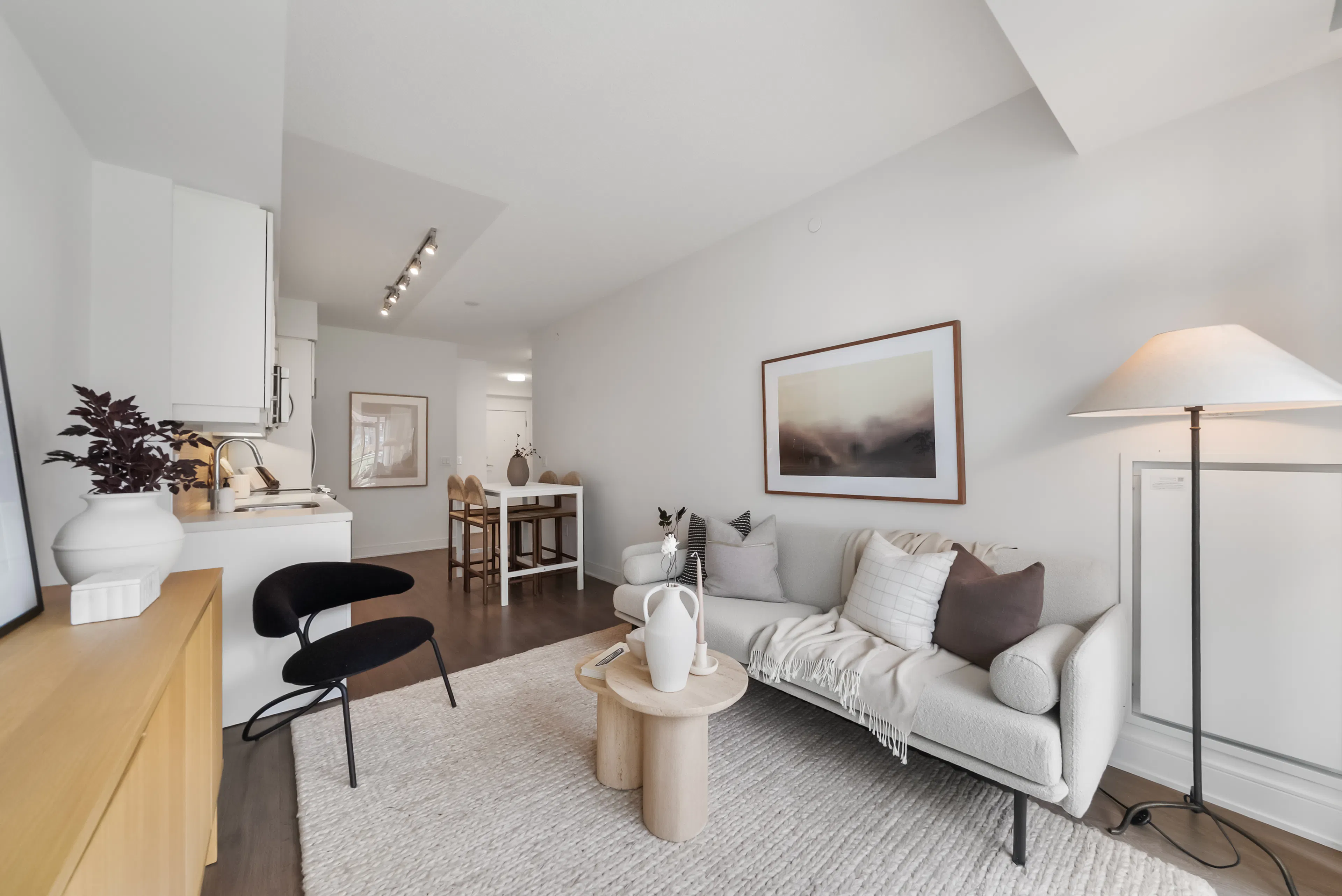
Professional staging is remarkably effective at making a home feel warm, spacious, and desirable. It is also entirely designed to obscure the things that will frustrate you the moment the moving truck arrives. Small rooms filled with well-scaled furniture. Awkward transitions between spaces masked by careful art placement. A principal bedroom that barely fits the staging bed, let alone yours.
Staging sells a feeling. You need to buy a floor plan. When you walk through a home, try to see through the furniture and ask the harder questions: Where does the natural light come from, and at what time of day? Do the main living areas flow sensibly for the way you actually live? Is the kitchen a functional work space or a photogenic one? Where does the mud from the kids' soccer cleats end up?
The homes that work best long-term are the ones with bones that make sense — not the ones that showed the best on a Saturday afternoon in June.
WHAT TO LOOK FOR
Walk the home without the agent narrative. Stand in each room for a full minute. Open every door — including closets and utility spaces. Imagine your furniture, your morning routine, and a dinner party of twelve. The staging will fade. The floor plan will not.
MISTAKE NO. 4
Not Considering Your Day-to-Day Life
Where is the closest grocery store? How far is the nearest park? Which school does this address feed into, and is that the school you actually want? Is there a TTC stop within a reasonable walk, or will you need a car for every errand?
These questions sound obvious, but they're consistently underweighted during the search. Buyers focus on the property, fall in love at the showing, and do the neighbourhood due diligence after the offer is firm — if at all.
Here's a concrete example. At $1.5 million, you can buy a home in Davisville Village or in parts of Scarborough. The budgets overlap. The homes — detached, semi, updated or original — will vary in condition at any price point in both areas. But the day-to-day life those two locations produce is fundamentally different. Davisville puts you steps from a subway station, June Rowlands Park, and the shops and restaurants along Mount Pleasant and Yonge. Scarborough, depending on the specific street, may require a car for nearly everything — groceries, transit, school drop-off, the doctor. Neither is the wrong answer. But they're not interchangeable, and buyers who treat $1.5M as the only relevant variable often end up surprised by what they actually bought.
In Toronto's freehold market, the neighbourhoods I work in most — Rosedale, Summerhill, Moore Park, Davisville Village, Leaside, Lawrence Park — each have distinct day-to-day rhythms. Davisville is exceptionally walkable. Leaside is more car-oriented but offers some of the best family streets in the city. These aren't minor lifestyle nuances. They define what your mornings look like for the next decade.
Map your daily life before you commit to a location. Walk the route to the school. Drive home from your office at 6pm. Buy a coffee from the corner café. Live the neighbourhood on paper before you live it in person.
Questions worth answering first
Nearest grocery store & walk time. School boundary and waitlist status. Park access for kids and dogs. TTC or GO commute to your office. Street parking and traffic at school drop-off time.
What buyers often skip
The evening noise level. Whether the street gets plowed early. The distance to the nearest emergency room. What the neighbours do on Saturday mornings. How far the nearest good coffee is at 7am.
MISTAKE NO. 5
Waiting for Someone Else to Offer First
This one is the most psychologically interesting — and the most expensive. A buyer finds a home they love. They know it works for them. And yet they hold back, wanting to "see what else comes to market". The real estate equivalent of waiting by the phone.
What I've seen happen, reliably, is this: another buyer submits an offer. Now the first buyer wants to offer as well — only now they're competing, bidding against someone else, and paying for the privilege of having hesitated. The very thing they were trying to avoid (making a mistake) has now been guaranteed by the delay.
The psychology here is worth naming directly. We want to know that someone else wants the same thing we want. It validates the decision. If another buyer is interested, it must mean the home is good — and therefore we're not making a mistake by pursuing it. It's social proof applied to real estate, and it is an enormously costly instinct.
The best homes in Toronto's freehold market don't sit. If the home works for you — the location is right, the floor plan functions, the numbers make sense — be the first to the dance. Don't create the competition you fear by waiting for it to appear.
"We wait for someone else to offer because it validates our instinct. But waiting is exactly what creates the competition we were trying to avoid."
WHERE YOU STAND
ACTIVELY SEARCHING
Get pre-approved before your next showing. Make a list of your non-negotiables — floor plan, school, commute — and use it as a filter before you let the staging do its work.
ABOUT TO START
Spend time in the neighbourhoods you're considering before you spend time in the houses. Walk them on a weekday morning. That context will sharpen your criteria faster than any listing search.
WATCHING FROM THE SIDELINES
The buyers who move confidently in this market are the ones who did the preparation work long before they needed it. If you plan to buy in the next twelve months, start the mortgage conversation now.
Most of these mistakes don't come from inexperience — they come from letting emotion lead before preparation has done its job. The fix is simple, but it requires doing the work before the home you want hits the market. By then, it's usually too late to start.